TANG JU YI
Architecture Degree Portfolio
Design Communication
Project 1A - On-Site Sketching
Students are required to engage with the site by experiencing it through a spatial sequence of our choice. While moving in sequence, we are required to record your observation and perception of the spaces and the human habitation of these spaces through free-hand sketches. This sequence must include both exterior and interior spaces.
We are required to capture/emphasize the following aspects of the built environment within the site to demonstrate our understanding of space:
-
Solids and voids: Form, Skin, Structure
-
Opening/Aperture; openness/enclosure; inside/outside; light/shadow
-
Rhythm in architecture
-
Details
-
Textural effects/Materials
-
Landscape/Setting
-
Scale and proportion (Relation to human and other surrounding built environment)


Project 1B - Tonal Values
Based on the selected image, we are required to produce four variations of a tonal value sketch. We can vary the sketches in the hatching type and medium. Examples of hatching types include stippling, cross-hatching, one-directional (hatching) and scribbling. We may choose to use pen, pencil & color pencil or mixed media.
The objectives of this project are as follows:
-
To understand the notion of space & detailing’s in architecture and objects.
-
To develop skills in communicating the above in various tonal and depth values.
-
To develop various techniques of hatching through different medium.


Project 2A - Orthographic projections
The Learning Outcomes of this project are:
-
Demonstrate drafting skills in modern and traditional methods of architectural drawing.
-
Record and present clear and legible architectural information manually.
-
Identify and apply architectural conventions and symbols.
-
Demonstrate in pencil and ink examples of: line type, line weight, line quality, hand lettering.

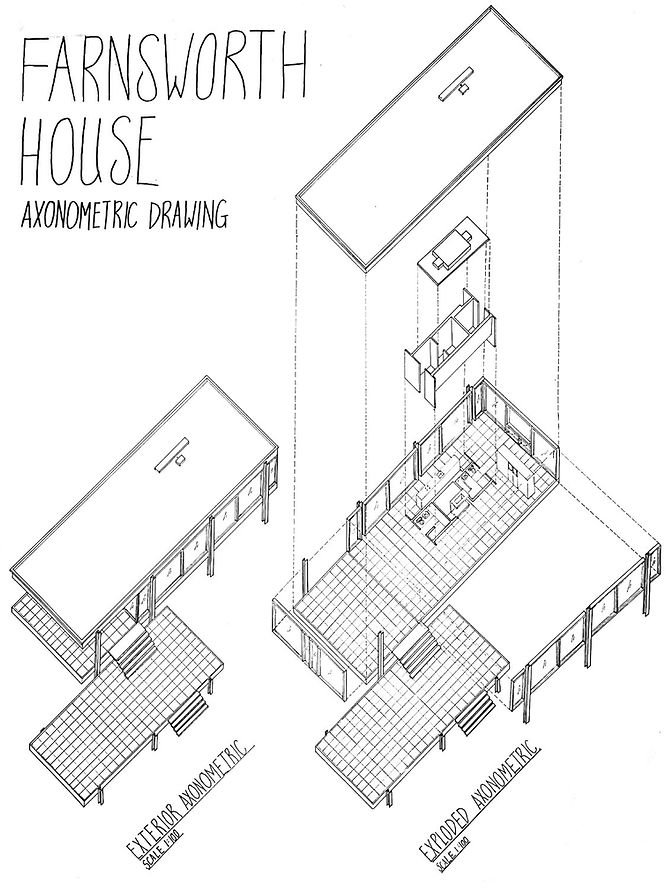
Project 2B - Axonometric Projection
We learn how to execute an axonometric projection by generating partial of an external and a sectional (internal) axonometric of the house.
Learning Outcomes of this Project
-
Ability to express spatial ideas and architectural detail in three-dimension, in the format of an axonometric projection.
-
Understanding of what axonometric projections are, how to generate them and how to apply them to the design process and presentation.
-
Ability to produce legible architectural drawings.
Project 2C - Perspective
This assessment introduces perspective as a mode of communication in architecture. We are required to construct firstly, one exterior (two-point) perspective followed by one sectional interior perspective (one- point).
In constructing both these perspectives, we are to demonstrate the ability to express spatial idea in 3-D form, understanding of 2-D and 3-D relationships in architectural graphics, skills in drawing and composition, creativity and complexity of drawing. Also, our selection of space and exterior form is significant.
